
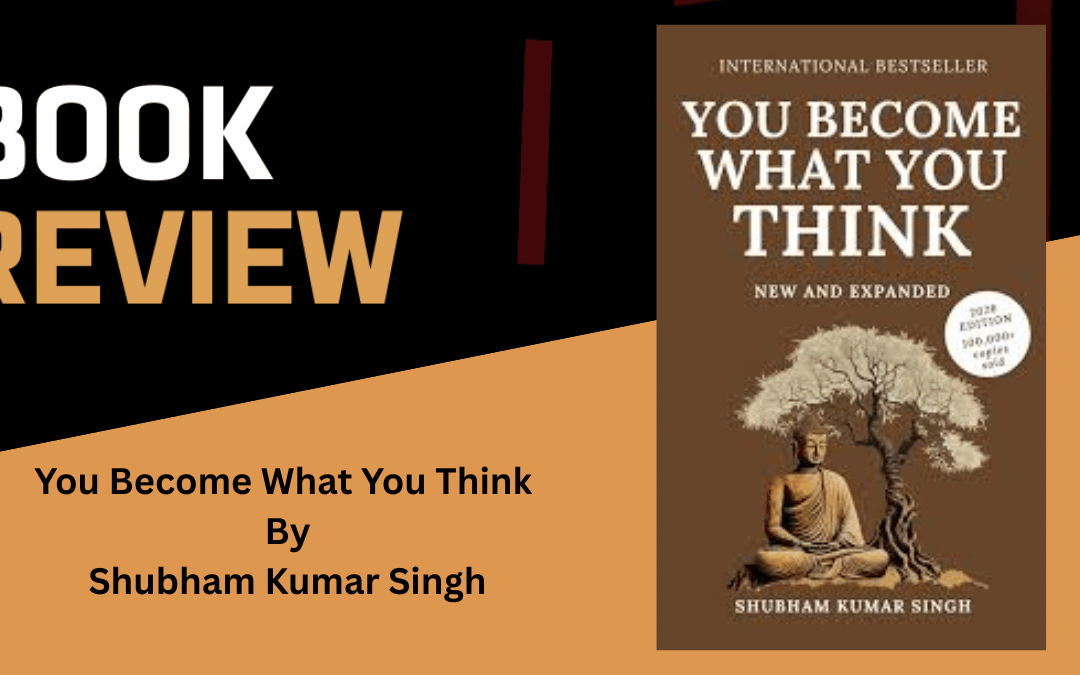
I will be honest with you about how I picked this book up. I was skeptical before I read the first page.
The premise, that your thoughts shape your reality, is not new. It shows up in ancient philosophy, in modern neuroscience, in half the self-help titles published in the last two decades. I have read Carol Dweck’s research on growth mindset. I have spent time with stoic frameworks and Buddhist ideas about the nature of perception. When a book promises to cover all of this ground in a single volume, my instinct is usually that something is going to be thin.
What Shubham Kumar Singh did surprised me. The book is not thin. It is carefully distilled.
What the Book Actually Argues
The central claim is straightforward: the quality of your inner life determines the quality of your outer life. Singh traces this idea across traditions, from Buddhist teachings on the relationship between thought and reality, to Stoic philosophy on distinguishing what is within your control from what is not. He does not pretend this is a new insight. He builds a case for why it keeps being true and why most people still fail to act on it.
The mechanism he focuses on is the feedback loop between belief and behavior. Limiting beliefs do not stay in your head. They shape how you act, which produces outcomes that confirm what you already believed. A person who believes they are not capable of something finds subtle ways to avoid testing that belief. The belief protects itself by preventing the experience that would challenge it.
Positive beliefs work the same way in the opposite direction. Expect competence, and you approach challenges differently. You persist longer. You interpret setbacks as information rather than verdicts. Over time, the outcomes shift.
This is consistent with what Dweck’s research demonstrates about fixed and growth mindsets, and Singh acknowledges that connection. What he adds is practical texture. Not just the what and why, but the how: specific habits and thought patterns to examine, and concrete approaches for beginning to shift them.
What Singh Does Differently
The author’s background matters here. Singh is a reader and blogger who came to this material the same way many of us do: through books, through personal searching, through the experience of feeling stuck and then finding something that helped. He is not a credentialed academic presenting research findings. He is someone who has worked through a substantial body of personal development literature and synthesized what he found most actionable.
That perspective gives the book a different feel from something like Dan Harris’s 10% Happier, which is grounded in a specific practice and a specific kind of skepticism, or from Dweck, whose work is anchored in decades of psychological research. Singh’s authority is experiential rather than institutional. Depending on what you are looking for, that is either a limitation or a feature.
For me, it was a feature in this context. The book reads the way a thoughtful friend would talk to you about ideas that changed how they live. Not a lecture. Not a research summary. A conversation about what works.
Where It Is Strong
The strongest sections cover resilience and the internal response to difficulty. Singh’s treatment of how to handle criticism, maintain motivation through setbacks, and build genuine confidence rather than performed confidence is practical in a way that is rare in books of this type. Most books in the genre tell you to be resilient. This one gives you something to actually do when you are not feeling it.
The material on relationships is also worth reading. The connection between your internal narrative and the quality of your connections with other people is underexplored in most productivity-adjacent personal development writing. Singh draws that link clearly. How you see yourself shapes how you present yourself, which shapes what you attract and sustain in relationships. That is not a new idea either, but his framing of it is direct and honest.
Where It Falls Short
If you have already read widely in this space, some chapters will feel familiar. The sections on positive thinking and the law of attraction cover territory that will not surprise anyone who has spent time with this genre. Singh is careful not to be credulous, and he grounds these ideas in psychology more than in metaphysics, but readers looking for something genuinely new will find those sections less rewarding than the rest.
The book is also short. That is not necessarily a criticism, but it means some topics get less depth than they deserve. The material on Stoic acceptance of what is outside your control, for example, could carry a full chapter on its own. Here it gets condensed into principles that point toward deeper exploration rather than providing it. I found myself wanting more from those sections and turning to other sources to fill the gap. If that sounds familiar, Greg McKeown’s Essentialism and the Meditations of Marcus Aurelius both extend the ideas Singh introduces here.
Who This Book Is For
Someone new to personal development who wants a clear, accessible entry point will get significant value from this book. The ideas are well-chosen, the prose is readable, and the practical guidance is concrete enough to act on without a lengthy adjustment period.
Someone who has already read Dweck, Harris, Frankl, or any substantial portion of the stoic canon will find the book a useful reminder and synthesis rather than a revelation. That is still worth something. We often need to encounter ideas multiple times, in different framings, before they fully take hold.
What I appreciated most about Singh’s approach is that he does not oversell the process. The transformation he describes is real but gradual. Thought patterns built over years do not shift in a weekend. The book is honest about that, and that honesty is more useful than the breathless promises that dominate much of this category.
Verdict
A well-distilled, practically oriented guide to the relationship between mindset and outcomes. Best for readers new to personal development or those who want a clean synthesis of ideas they have encountered separately. Read it with a notebook. The real value is in the habits it prompts you to examine.You can explore more book reviews and writing on my journal page and learn more about my background on my biography page.
