
Amazon · Goodreads
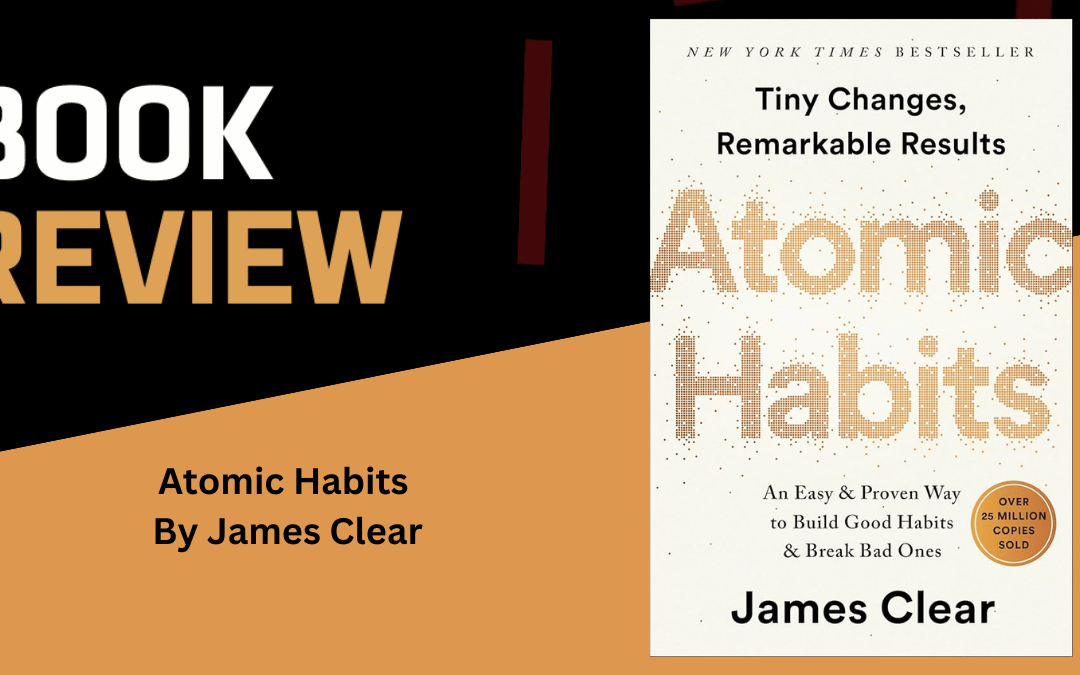
I avoided this book for years, precisely because everyone told me to read it. When a book sells millions of copies and shows up on every recommended list, my instinct is to assume it has been oversold. Popular and good are not the same thing, and I have been burned enough times to be cautious.
So I came to Atomic Habits expecting a competent, slightly repetitive entry in a crowded genre. What I found was the rare book that earns its reputation. It is not perfect. But the core argument is sound, the structure is genuinely useful, and one idea in particular has stayed with me long after I finished it.
The Idea That Changes Everything
The insight at the center of Atomic Habits is deceptively simple. You do not rise to the level of your goals. You fall to the level of your systems.
Most of us are taught to focus on goals. Set the target, work toward it, achieve it. James Clear argues that goals are nearly useless as a driver of lasting change, because everyone competing for the same outcome has the same goal. What separates the people who succeed from the people who do not is not the goal. It is the system of daily behaviors that either carries them toward it or does not.
This reframes the entire project of self-improvement. Instead of asking what do I want to achieve, you start asking what system would make that achievement inevitable. The goal becomes almost irrelevant once the system is right. I found this genuinely clarifying, and it connects directly to something I wrote about in my essay on the 1% Rule, where the entire point is that falling in love with the process matters more than fixating on the outcome.
Identity Is the Real Lever
The part of the book that affected me most was Clear’s argument about identity. He describes three layers of behavior change: outcomes, processes, and identity. Most people work at the outcome level. They want to lose weight, write a book, or build a business. Some get as far as the process level, focusing on the routines. Very few work at the identity level, which is where Clear says real change actually happens.
The distinction is this. The goal is not to read a book. The goal is to become a reader. The goal is not to run a marathon. The goal is to become a runner. When a behavior becomes part of how you see yourself, it stops requiring willpower. You do it because it is who you are.
This resonated deeply with what Carol Dweck describes in Mindset. Both books point to the same underlying truth: the story you tell yourself about who you are shapes what you actually do. Clear takes that insight and makes it operational. Every action you take, he argues, is a vote for the type of person you want to become. You do not need a unanimous vote. You just need to build a majority over time.
The Four Laws Are Genuinely Useful
The practical core of the book is the Four Laws of Behavior Change. Make it obvious. Make it attractive. Make it easy. Make it satisfying. To break a bad habit, you invert each one. Make it invisible, unattractive, difficult, and unsatisfying.
What I appreciate about this framework is that it is actually actionable. A lot of personal development books leave you inspired but unsure what to do on Monday morning. Clear gives you specific tactics. Habit stacking, where you attach a new habit to an existing one. The two-minute rule, where you scale a habit down until starting is trivially easy. Environment design, where you shape your surroundings so the right behavior becomes the path of least resistance.
These are small, concrete tools. They work because they reduce the reliance on motivation, which Clear correctly identifies as unreliable. Greg McKeown makes a complementary point in Essentialism: the goal is to make the essential things effortless rather than depending on discipline to force them. Clear and McKeown are working the same territory from different angles.
Where the Book Has Limits
I want to be honest about what Atomic Habits does not do, because the praise can become uncritical.
First, very little here is genuinely new. The behavioral science Clear draws on has been documented for decades. The habit loop, the role of environment, the power of small wins, these are established ideas. Clear’s contribution is synthesis and clarity, not original discovery. If you have read deeply in behavioral psychology, parts of this will feel familiar.
Second, the book is strongest for habits that are concrete and individual. Exercise, reading, writing, small daily routines. It is less helpful for the messier, more complex changes that involve other people, deep emotional patterns, or circumstances outside your control. Not every problem is a habit problem, and the book occasionally implies that the right system can solve almost anything. It cannot.
Third, the relentless optimization can start to feel airless. Oliver Burkeman’s Four Thousand Weeks is a useful counterweight here. There is a version of the habit-optimization mindset that turns your entire life into a productivity project, and that is not the same thing as a life well lived. Clear is not advocating that extreme, but some readers take his framework there, and the book does little to discourage it.
Who Should Read It
If you have struggled to build or break a specific habit and you want a clear, practical system, this book delivers. The frameworks are sound, the writing is clean, and the tactics work when you actually apply them. It earns its place as the standard reference on habit formation.
If you are looking for something philosophically deep or emotionally transformative, this is not that book, and it does not try to be. It is a practical manual, and it is an excellent one. Read it with the understanding that it solves a specific class of problem extremely well and leaves the larger questions of meaning and purpose to other writers.
Verdict
The best practical book on habit formation available, and a rare case where the popularity is earned. Read it for the systems-over-goals reframe and the identity argument, both of which are genuinely clarifying. Keep a notebook handy. The value is in applying one or two ideas consistently, not in admiring the whole framework at once.More book reviews and writing are available on my journal page.
