
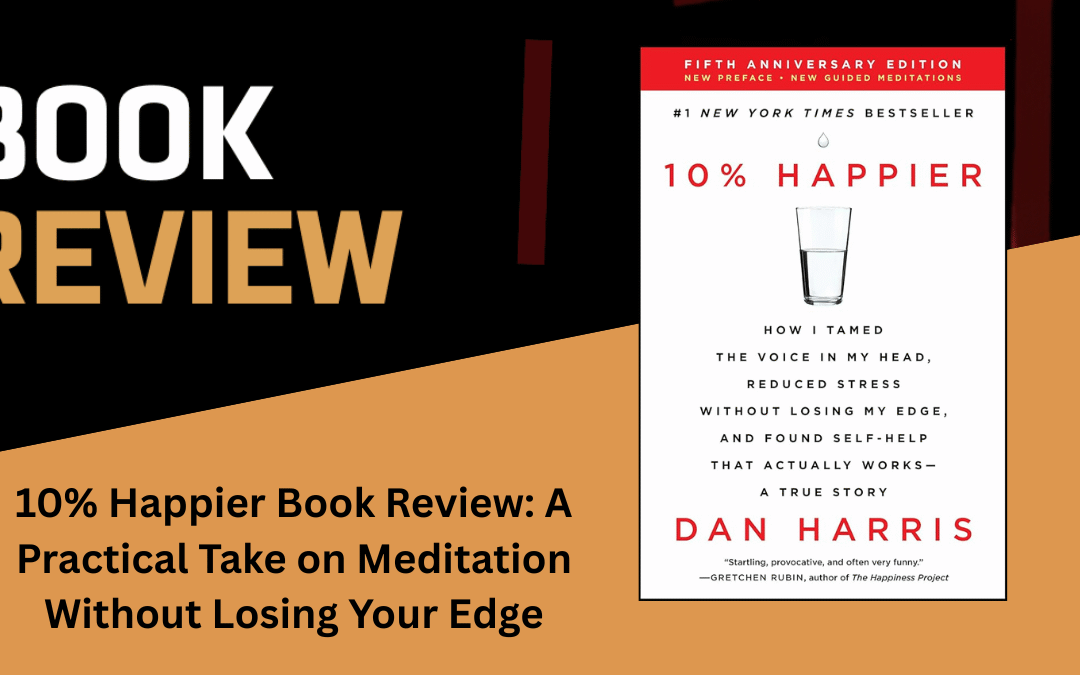
When I picked up 10% Happier, I was unsure. I imagined an old meditation cushion and the scent of sandalwood, wondering if I would have to trade ambition for calm. I questioned whether the book would actually help or simply offer another way to avoid real life.
I was not looking to become calmer at the cost of ambition.
I was not interested in incense, chanting, or escaping reality.
I wanted something practical.
Dan Harris surprised me.
This book is not a promise of total peace.
It makes a small, honest claim.
You can be a little less reactive.
A little less hijacked by your own thoughts.
About ten percent happier.
That framing matters.
Most self help books aim too high.
They sell transformation.
They sell certainty.
They sell a future version of you that feels unrealistic.
Harris does the opposite.
He lowers the bar.
And that is why it works.
The story begins with his on air panic attack.
It is public.
It is embarrassing.
It is human.
Rather than turning it into a dramatic comeback, he treats it like information. In that moment, he notices his fast heartbeat and racing thoughts. That brief awareness shows him how disconnected he had become from his own mind. Something was off. Something inside him was out of control. Something inside him was running unchecked.
What I appreciated most is that Harris does not pretend the voice in his head disappears.
He does not promise inner silence.
He does not claim enlightenment.
He learns how to relate to that voice differently.
That distinction is everything.
Many self help books try to eliminate discomfort. This one shows you how to sit with it without letting it take over. Instead of treating the mind as an enemy, Harris treats it like something that needs attention and training. He even gives his inner critic a name, not to defeat it, but to recognize it. That shift changes how he responds to his thoughts. He stops fighting them and starts observing them.
That approach feels more real.
Harris approaches meditation the way a journalist would.
He questions it.
He resists it.
He interviews people who believe in it deeply.
He also admits how annoying it feels at first.
The wandering mind.
The boredom.
The frustration of sitting still.
That honesty builds trust.
Here is the contrarian part.
Meditation does not make you softer.
It makes you sharper.
There is a fear that mindfulness dulls ambition.
That if you calm down, you will stop pushing.
That your edge will disappear.
Harris shows the opposite.
When you react less, you waste less energy. When you notice your thoughts, you do not have to obey every one of them. You gain distance. You gain choice.
That creates space.
Space is power.
You still care.
You still strive.
You just do it without the constant background panic.
Another thing I liked is how little time this requires. In my own life, I have struggled to make room for new habits while juggling work and personal responsibilities. The idea of a long morning routine feels unrealistic. That is why Harris’s approach resonated with me. He is not asking for a lifestyle overhaul. He talks about minutes. Short sessions. Small habits. He is not selling a perfect routine. He is offering something doable.
That matters for people who live in the real world.
The book also avoids spiritual superiority.
There is no sense that meditators are better people.
There is no moral pedestal.
Harris describes meditation as mental training. Like working out, but for your attention. That comparison stays with you.
Your mind will wander.
That is not failure.
That is the exercise.
Each time you notice and return, you are doing the work.
This reframing removes guilt.
It replaces judgment with curiosity.
One of the most useful ideas in the book is learning to see thoughts as events.
Not commands.
Not facts.
Just things that arise.
That sounds simple.
It is not.
But once you experience it, even briefly, it changes how you respond to stress.
You pause.
You notice the surge.
You choose your next move.
That pause is where growth happens.
Harris also does something rare.
He admits that meditation is not magic.
It will not fix everything.
It will not make life easy.
It makes things slightly better.
And those small gains compound.
Ten percent calmer conversations.
Ten percent less rumination.
Ten percent more clarity under pressure.
Over time, that adds up.
What I respect most is that this book does not try to replace therapy, ambition, or hard work.
It sits alongside them.
It is a tool.
Not an identity.
For people who are skeptical of self help culture, this book offers a middle ground. It does not ask you to abandon who you are or adopt beliefs that feel forced. It meets doubt with honesty and practicality.
Skeptical.
Practical.
Grounded.
You do not need to change who you are to benefit from it.
You just need to notice what is already happening inside you.
That is the quiet power of 10% Happier.
It does not ask you to become someone else.
It helps you stop fighting yourself.
And in a world full of noise, that feels like a competitive advantage.
Not enlightenment.
Not escape.
Just a little more space in your own head.
Sometimes that is enough.
