
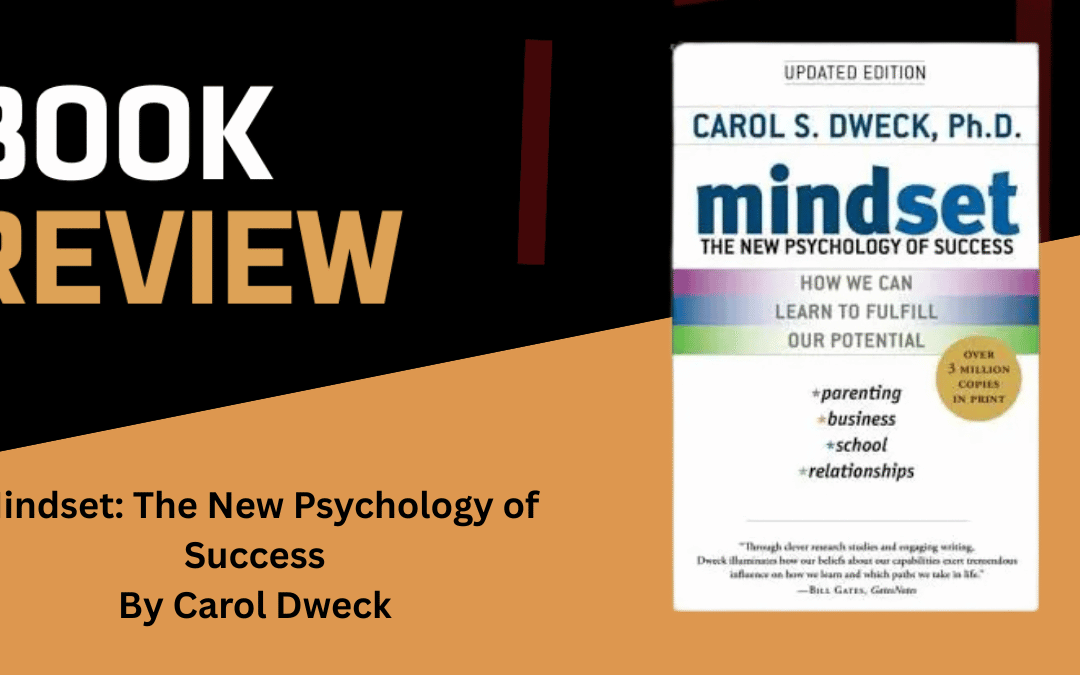
I picked up Mindset like I do with many popular books: feeling a bit skeptical.
People often talk about this book as if it instantly changes you, like flipping a switch. I did not feel that way. I did not finish the last page and become a new person. Honestly, I was relieved, because real change usually does not happen overnight.
What actually happened was much quieter.
I started noticing the way I talk to myself when something feels hard. It is not always loud. It is not always dramatic. Sometimes it is a small sentence that slips in fast, like it has been waiting for years.
I am not good at this.
I always mess this up.
They are better than me, so what is the point?
Before reading this book, I treated those thoughts as facts. I never questioned them. Instead, I changed my choices to fit them. I avoided things, put things off, or tried once and took any failure as proof.
Carol Dweck gives this pattern a simple name: fixed mindset. It means believing your abilities cannot change, so you focus on protecting your image. You choose the safe path, stick to what you know, and look for approval instead of growth.
She also describes another pattern: the growth mindset. This is the belief that you can develop skills over time, and that effort, strategy, and help all matter. You still fail sometimes, but you do not see failure as who you are.
I know it sounds like something you might see on a coffee mug. I thought so too. But as I read, I kept recognizing my own habits in the examples, which surprised me.
I kept thinking about how much I want to seem capable. It is not about having a big ego, just a normal, human wish. I want to feel steady, have people trust me, and trust myself too.
But the book made me realize that sometimes wanting to look capable actually keeps me from becoming capable.
Honestly, learning often looks messy at first. You might seem slow or awkward, ask simple questions, or make the same mistake again. If you dislike that feeling, you start avoiding things that bring it up.
This is where my different view comes in. People often say this book teaches you to love failure, but I do not think that is the main point. I still do not like failure. I still feel embarrassed when things go wrong.
The real benefit is that the book helped me stop seeing failure as a final judgment.
It helped me see failure as information, not as a label.
Another part that stuck with me was about praise. Dweck explains the difference between praising talent and praising process. This affected me more than I expected, because I realized I do this with myself, not just with kids.
When you praise talent, you create pressure. You make being “smart” or “gifted” feel like a fragile thing you might lose. Then you start protecting that label. You take fewer risks.
When you praise process, you focus on what someone did. The choices they made. The effort they put in. The way they practiced. The strategy they tried. That kind of praise points to things that can grow.
While I was reading, I started catching myself in real time. I would finish something and think, I am so bad at this. Then I would try to reframe it, but not in a cheesy way. More like, okay, what part is weak right now. What part can I improve next.
That is the thing. The growth mindset is not about lying to yourself. It is not about pretending everything is possible if you just believe hard enough. It feels more grounded than that.
It is about staying engaged.
It is about saying, I am not there yet. But I can take one step.
I also appreciated that the book does not pretend effort is the only thing that matters. Life is not a clean lab experiment. People have different support systems. Different time. Different energy. Different stress. Sometimes you can want growth and still need rest. Sometimes you can want growth and still need help.
So I do not like when people turn “growth mindset” into a weapon. Like if someone struggles, it must mean they did not want it badly enough. That feels cruel and lazy. And it misses the point.
For me, the best way to use this book is to keep it personal.
Not as a way to judge other people. Not as a way to prove you are enlightened. Just as a way to notice your own patterns and respond differently.
When I closed the book, I did not feel like I had solved myself. I felt like I had a new mirror.
And I think that is enough.
If you read this book, I would not go in looking for a big moment. I would go in looking for small sentences. The ones you repeat to yourself without noticing. Because once you start hearing them clearly, you can begin to change them.
Not all at once. Not perfectly. But steadily.
And that kind of change feels real.
