
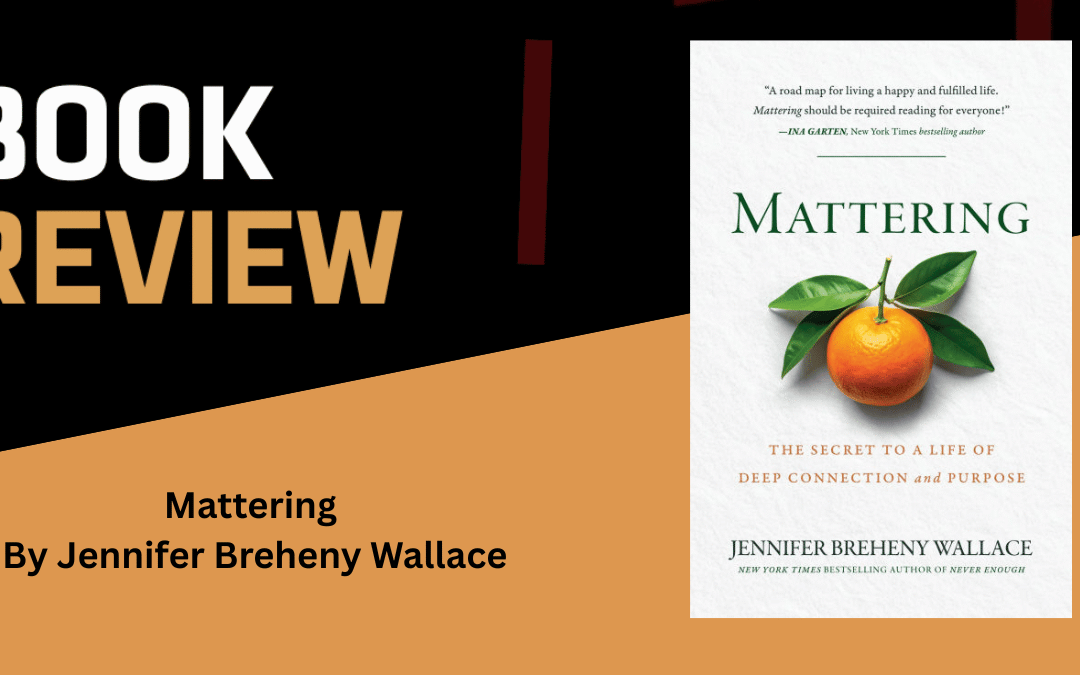
I picked up Mattering at a time when talk about success felt overwhelming. Everywhere I turned, it seemed like achievement was the only thing that mattered. Productivity became who you were, and being seen meant being valued. This book quietly challenged those ideas.
Jennifer Breheny Wallace does not argue that ambition is harmful. She argues something more precise. People suffer when achievement replaces connection. That distinction shapes the entire book and gives it clarity.
Mattering is about a basic human need. People want to feel valued and know they make a real difference to others. Wallace says both are needed for true mattering. If you feel valued but don’t contribute, you feel fragile. If you contribute but don’t feel valued, you burn out. The book’s strength is how simply it explains this balance.
A lot of self-help books focus on motivation, but this one relies on evidence. Wallace uses research from psychology, sociology, education, and her own reporting. The research always feels real, not distant. Each idea ties back to everyday life in families, schools, workplaces, and communities. That makes the book feel practical, not just theoretical.
One of the book’s most important contributions is its critique of modern pressure. Wallace explains how constant evaluation affects people over time. Grades, rankings, performance metrics, and public comparisons shape behavior in subtle ways. People start performing for approval instead of learning for growth. That shift damages confidence and weakens resilience.
The book is clear about this: resilience doesn’t come from always being tough. It grows when people feel supported as they face challenges. Wallace isn’t against hard work. She just explains that effort works best when people know someone cares about their progress.
This perspective feels quietly contrarian. Popular culture often celebrates self reliance and grit above all else. Wallace shows that connection strengthens grit rather than replacing it. Support systems do not make people soft. They make people steady.
Another strength of Mattering is that it doesn’t oversimplify things. Wallace doesn’t say that praise alone is enough. Empty compliments don’t make people feel they matter. Real recognition has to be specific, honest, and based on true contribution. Kids, students, and adults can all tell the difference.
The book also doesn’t blame anyone. Parents aren’t called failures. Teachers aren’t blamed for big problems. Leaders aren’t made out to be villains. Instead, Wallace shows how even well-meaning systems can lose sight of people’s needs. This way, she encourages responsibility without making anyone defensive.
Practical guidance appears throughout the book. Wallace emphasizes listening without rushing to fix problems. She encourages acknowledging effort rather than only outcomes. She highlights the importance of giving people meaningful roles instead of symbolic ones. These practices apply at home, at school, and at work.
The book is clear: mattering doesn’t mean lowering standards or protecting people from hard things. It means matching expectations with a sense of belonging. High standards are easier to handle when people know they matter.
While the book often talks about parenting, its ideas go far beyond family life. Managers will see familiar workplace issues. Teachers will notice patterns from their classrooms. Community leaders will understand how leaving people out can slowly break trust.
Even people who aren’t in charge can learn from this book. Wallace helps readers look at how they show others that they matter. Small actions shape the culture: who gets heard, who gets included, who gets credit. These choices add up and shape our surroundings.
The writing style is worth noting. The tone stays steady and respectful. Wallace doesn’t use emotional tricks. She makes her points patiently, and each chapter leads smoothly to the next. This makes the book easy to read and hard to ignore.
What sticks with you after reading Mattering isn’t a list of tips. It’s a new way of seeing things. Success looks different when it’s about contribution and connection, not just applause. Achievement feels better when it’s built on belonging.
This book doesn’t promise quick fixes. Instead, it offers something lasting—a way to see people more clearly. In a world that values performance over presence, that kind of clarity really matters.
Mattering works because it respects its readers. It assumes you’re thoughtful and that you care. It addresses real concerns without overdoing it.
If you’re wondering how to build healthier families, workplaces, or communities, this book is a thoughtful and trustworthy guide. It reminds us that people don’t thrive because they’re impressive – they thrive because they matter.
