
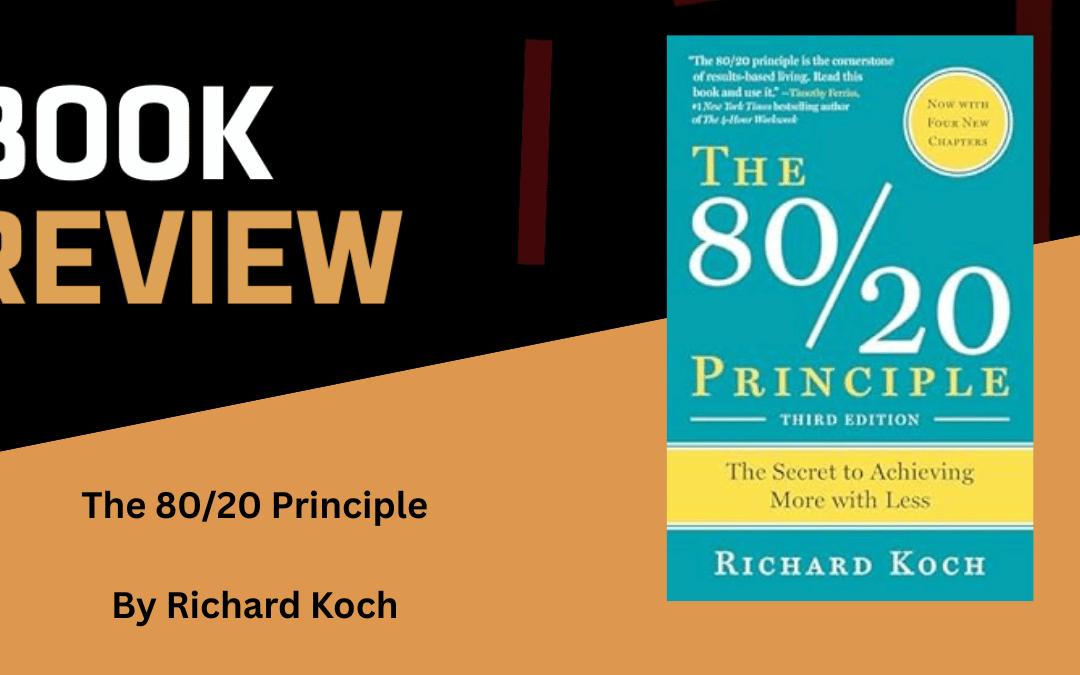
Most productivity books tell us to do more. They tell us to wake up earlier, plan harder, optimize everything, and squeeze more into each day. Richard Koch takes a different path in The 80/20 Principle. That alone makes the book worth reading.
Its core idea is simple. A small number of causes often create most of the results. In plain terms, 20 percent of what you do may create 80 percent of your progress. Koch argues that this pattern shows up in business, money, relationships, and daily life.
That idea may sound familiar now. However, when you sit with it, the message feels more radical than trendy. This is not just a book about time management. It is a book about judgment. It asks a harder question: what if most of your effort is not helping you nearly as much as you think?
That is where this book becomes powerful.
What I like most about The 80/20 Principle is that it pushes back against a belief many people quietly carry. We often assume effort and value rise together. We think the busier person is the more effective person. Koch challenges that idea without sounding lazy or careless. Instead, he argues that smart focus beats constant motion.
I find that view refreshing.
In fact, my contrarian take is this: the best part of the book is not that it helps readers get more done. The best part is that it gives people permission to stop doing low value work. That matters. Many readers do not need another system to fill every hour. They need a reason to protect their energy and use it with more care.
Because of this, the book feels less like a productivity manual and more like a filter for modern life.
Koch writes with confidence. He uses examples from economics, business, and personal success to explain why unequal results happen so often. Some chapters feel especially strong when he applies the principle to wealth creation and business growth. He shows how a few products, clients, or decisions often drive the bulk of returns. For entrepreneurs, managers, and professionals, that lesson lands quickly.
At the same time, the book reaches beyond business. Koch also encourages readers to use the principle in their personal lives. He suggests that a few relationships may bring most of our happiness. A few habits may shape most of our success. A few choices may create most of our stress. That wider lens gives the book staying power.
Still, this is not a perfect book.
At times, Koch repeats the idea in slightly different ways. Readers who already understand the main point may feel that some sections go on too long. The writing is clear, but the book can feel heavy in places because it returns to the same logic again and again. Even so, I would rather read a book that explores one strong idea deeply than one that rushes through ten weak ideas.
Another issue is practical use. The principle sounds easy. Living it is harder. It takes honesty to admit that some tasks, meetings, or goals do not deserve your time. It also takes discipline to act on that truth. Koch gives readers the framework, but the real work begins after the final page.
That said, the book remains useful because it changes how you think. Once you start looking for the vital few instead of the trivial many, your decisions shift. You begin to question where your time goes. You notice which efforts truly move the needle. You stop treating every task as equally important. That mental shift alone can improve work and life.
I also appreciate that the book rewards rereading. On a first read, it may seem like a sharp business idea. On a second read, it feels more personal. You start seeing where you waste energy. You notice where you chase volume instead of value. Meanwhile, the book quietly asks you to become more selective, not more intense.
That is a message many readers need.
Here is another positive but contrarian opinion: The 80/20 Principle is not really about efficiency. It is about courage. It takes courage to choose less. It takes courage to disappoint people who expect constant availability. It takes courage to focus on what matters most and let the rest stay unfinished. Koch may frame the book around results, but underneath that, he is making a case for a more intentional life.
That is why the book still feels relevant.
In a world full of noise, more options do not always help. More information does not always lead to better choices. More work does not always produce more value. Koch reminds us that better results often come from subtraction. That idea may sound small, yet it can change how a person works, leads, spends, and lives.
I would recommend this book to business owners, professionals, students, and anyone who feels buried by too many demands. It is especially helpful for readers who work hard but suspect that hard work alone is no longer enough. If you want a book filled with constant motivation and flashy hacks, this may not be your favorite. However, if you want a book that sharpens your thinking, this one delivers.
My final view is simple. The 80/20 Principle earns its place because it offers a timeless idea with practical reach. Some parts repeat. Some examples feel more useful than others. Yet the central lesson is strong, clear, and worth revisiting.
Read it for productivity if you want. Read it for business if that is your goal. But more than anything, read it as a reminder that not everything deserves equal attention.
That is a lesson many people hear.
Very few actually use it.
For more reflections, visit the journal, browse other publications, or explore more book reviews such as 12 Rules for Life, Buy Back Your Time, The Lost Bookshop, Never Split the Difference, Greed Is God, Can’t Hurt Me, The Power of Now, and All the Ugly and Wonderful Things. You can also learn more on the biography page or return to the homepage.
