
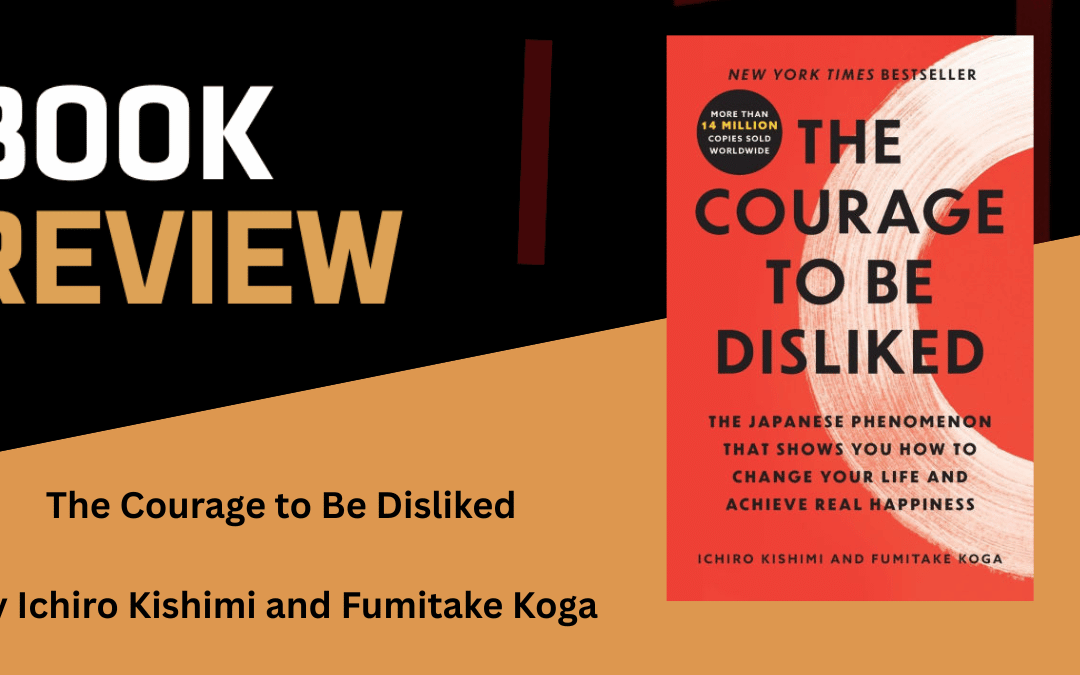
Most self help books try to comfort you first.
This one does not.
That is exactly why The Courage to Be Disliked stands out.
Written by Ichiro Kishimi and Fumitake Koga, the book uses a conversation between a philosopher and a young man to explore ideas based on Adlerian psychology. At first, that setup sounds a little stiff. You may expect something dry or overly academic. But the book moves faster than you think. It feels more like a debate than a lecture. Because of that, it pulls you in.
My view is simple. This is not a perfect book. Still, it is one of the most useful books for people who feel stuck in other people’s opinions.
That is a big reason I respect it.
Many books about confidence tell readers to believe in themselves. That sounds nice, but it often stays vague. The Courage to Be Disliked takes a sharper path. It argues that many of our struggles come from the way we interpret life, not just from what happened to us. That is a bold claim. For some readers, it may even sound too blunt at first. However, that bluntness is also what gives the book its force.
The core message is not that pain is fake. It is not that the past does not matter. Instead, the book pushes a more challenging idea. It says we have more freedom than we think. We are not as trapped as we often tell ourselves.
I find that idea refreshing.
In today’s world, people almost compete to explain why they cannot change. We hear endless talk about limitations, labels, and fixed traits. Some of that has value. Self awareness matters. Understanding your patterns matters. Still, I think many people become too loyal to their own story. They protect it. They polish it. They repeat it until it becomes a cage.
This book refuses to admire the cage.
That is the contrarian strength of The Courage to Be Disliked. It does not flatter the reader. It does not say, “You are right to stay exactly as you are.” Instead, it asks, “What are you gaining by staying this way?”
That question can sting. Yet it can also wake you up.
One of the most memorable ideas in the book is the concept of separating tasks. In simple terms, it means learning what belongs to you and what belongs to other people. Your task is how you act. Their task is how they respond. This sounds obvious, but very few people live this way. Most people spend huge amounts of energy trying to manage reactions, approval, and image.
That is exhausting.
The book argues that freedom begins when you stop making other people’s opinions your full time job. I think that message lands hard today because so much of modern life encourages performance. Social media rewards image. Work culture often rewards people pleasing. Even friendships can turn into quiet competitions for approval. Because of this, many people no longer know the difference between being kind and being controlled.
This book does.
Another reason I like it is that it challenges the popular idea that hardship must define a person forever. That does not mean hardship is small. It means hardship does not have to be the final author of your identity. That is a hopeful idea. It gives the reader some dignity back.
At the same time, the book may frustrate some people. The philosopher often sounds too certain. The young man can feel dramatic. A few arguments seem repeated more than needed. Also, the book sometimes presents life as if a mindset shift alone can solve almost everything. Real life is messier than that. Growth takes time. People need support. Change is not always neat.
Still, I would rather read a book that pushes too hard than one that says nothing at all.
That is another contrarian point worth making. Not every helpful book needs to feel warm. Some books help by comforting you. Others help by confronting you. The Courage to Be Disliked belongs in the second group.
What makes it work, though, is that the confrontation is not cruel. Underneath the challenge, there is a deeply positive message. The book believes people can change. It believes people can live with purpose. It believes we do not need to be ruled by fear, praise, or the past. That is not a cynical worldview. It is a generous one.
I also appreciate that the book values contribution over ego. It suggests that a meaningful life is not built by winning status games. It is built by being useful, honest, and connected to others. In a culture obsessed with personal branding, that feels almost rebellious. Yet it also feels healthy.
Not everything in the book will click for every reader.
Some readers will love the directness. Others will resist it. Some will see freedom in its message. Others will see oversimplification. Both reactions make sense. This is not a soft book. It asks for real self examination. If you only want quick motivation, this may not be the right fit. But if you are ready to question the way you think, it offers real value.
My final take is positive.
The Courage to Be Disliked is worth reading because it does something rare. It gives readers a harder truth in service of a better life. It says you may not control everything, but you still have choices. You still have responsibility. And because of that, you still have power.
That message may feel uncomfortable at first.
Good.
Sometimes discomfort is not a warning sign. Sometimes it is the sound of an old excuse losing its grip.
For readers who feel overly shaped by approval, fear, or old stories, this book has real weight. It may not agree with everything you believe. In fact, it probably will not. But that is part of its value. It does not just want your attention. It wants your honesty.
And in the end, that may be the bravest thing about it.
For more reflections, visit the journal, browse other publications, or explore more book reviews such as 12 Rules for Life, Buy Back Your Time, The Lost Bookshop, Never Split the Difference, Greed Is God, Can’t Hurt Me, The Power of Now, and All the Ugly and Wonderful Things. You can also learn more on the biography page or return to the homepage.
